CR-NX range

Cartesian robots CR-NX for Industrial Automation.

Cartesian robots for picking, transferring and palletizing products. Delta control, configurable transmissions and software developed by Carioli connect movements to process needs.

Request an assessment and quote

Cartesian technology

A clear architecture.
A technical selection for each operation.

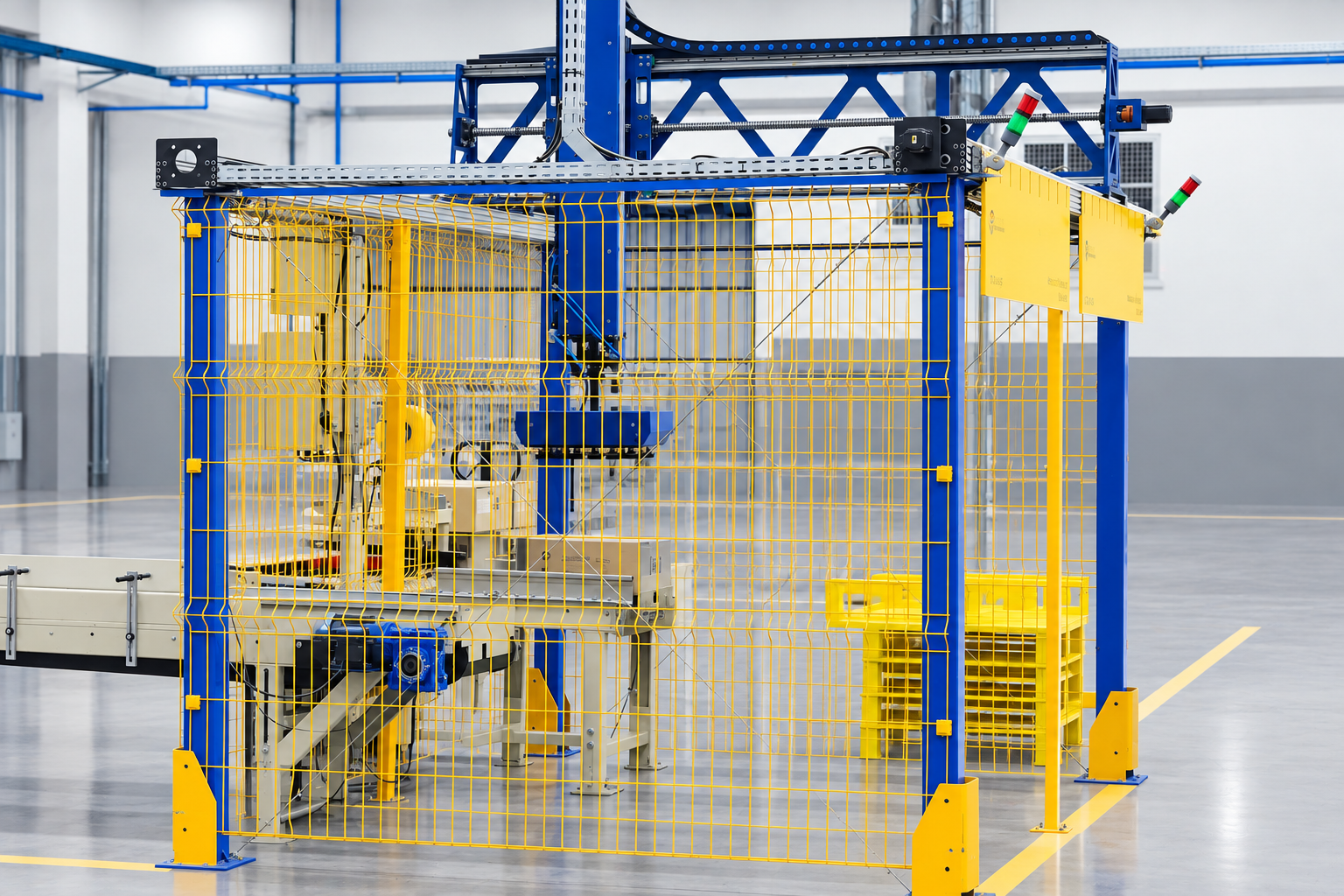
In the palletizing configuration, the CR-NX combines the linear movements X, Y and Z with the rotation of the gripper: four degrees of freedom to move and guide the product in the formation of the pallet.

In the CR-NX designation, N indicates the number of axes. The structure, axis travel, drives and tooling are defined together, taking payload and cycle time into account. Recirculating-ball linear guides form the mechanical foundation of the axes.

Cartesian robot configuration of Carioli Engenharia with linear axes and gripper
Representation of a Carioli configuration. Structure and devices vary depending on the technical selection.

The models in the line

A column, a portico or two porticoes.

Discover the three structures and their main applications: CR-NX-1C for injection molding outlets, CR-NX-1P for pick & place and CR-NX-2P for palletizing.

Compare the three CR-NX models
CR-NX-1C · 1 column
Mainly used at injection molding outlets.
CR-NX-1P · 1 gantry
Mainly used in pick & place.
CR-NX-2P · 2 gantries
Mainly used in palletizing.

Priority applications

From the machine exit to the next destination.

Discover the main operations supported and explore the criteria for each one on the Applications page.

Explore all applications

Product removal

Removal at the exit of machines and conveyors, with transfer to packaging, organization or palletizing. Synchronization with the existing machine is part of the analysis.

Technical reference: removal of boxes at the exit of folder-gluers in the graphics sector, described in the Carioli guide.

Movement and positioning

Repetitive transfer between defined positions, station feeding and product organization. The trajectory, orientation and stability of the load guide the selection.

Palletizing loads

Arrangement of products on pallets, considering the sequence of layers, stacking height and access. An application aimed at reducing repetitive manual lifting.

Configuration criteria

What we need to know about your operation.

The selection considers the set. We do not define capacity, speed or accuracy based on a single isolated piece of data.

Product and payload
Mass, dimensions, center of mass and contact surface. The weight of the gripper is also included in the evaluation.
Axes and travel ranges
Number of axes, displacements and orientation required to meet pick-up and delivery points.
Gripper and fixture
Way of gripping, retaining, orienting and releasing the product, according to its characteristics.
Cycle and dynamics
Time available for movement, trajectory, accelerations and synchronization with production.
Layout and integration
Usable space, height, interference and communication with existing machines, conveyors and sensors.
Operation and safety
Access, operating modes, guards and safety functions assessed for the complete application.

Technology and components

The engineering behind every movement.

Discover the technological base of the CR-NX: motion controller, servo system and Delta HMI, inductive sensors, gripping tools and operation protection.

The range combines Delta technology with Carioli engineering. Power ratings, axis travel, tooling and enabled features are defined for the application and detailed in the technical proposal.

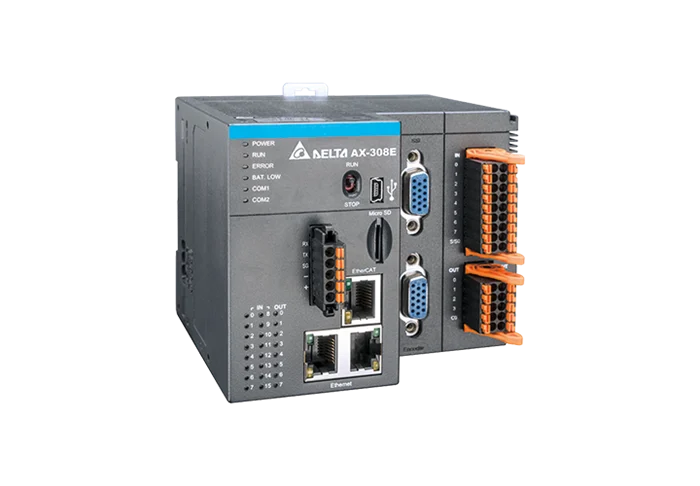
Delta AX-308E motion controller with connection terminals and communication interfacesDelta AX-308E motion controllerCoordinated movement in EtherCATDelta AX-308 Controller

Motion controller from the AX-3 family, based on CODESYS. Coordinates the CR-NX axes and the exchange of signals with the line's machines.

Schedule
CODESYS, with IEC 61131-3 languages and PLCopen motion functions.
Timing
Up to 8 servo axes via EtherCAT on the controller. The amount used depends on the robot configuration.
Trajectories
Multi-axis interpolation, electronic gearing and electronic cam to coordinate movements.
Integration
OPC UA, EtherNet/IP and Modbus for communication with supervisors and other systems, according to the project interfaces.
Expansion
16 onboard digital inputs and 8 outputs, with expansion via AS series modules.
Delta Documentation · AX-308E
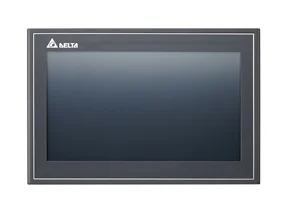
Delta DOP-110WS touchscreen interface, with 10.1-inch widescreen displayDelta DOP-110WS · operation interface10.1-inch screen operationDelta DOP-110WS HMI

The touchscreen interface concentrates commands, parameters and process information. The operator follows the machine and configures the application data on the screen.

Screen
10.1-inch widescreen TFT, 1024 × 600 resolution and integrated Ethernet.
Operation
Recipes, trend graphs and alarm history, depending on the configured screens and functions.
Monitoring
VNC server and browser monitoring of registrars. Access depends on the network and configured permissions.
Remote access
It can be restricted to monitoring, without remote commands, depending on the interface configuration.
Records
Features for sending alarms by email and time synchronization via NTP, when enabled in the project.
Delta Documentation · DOP-110WS
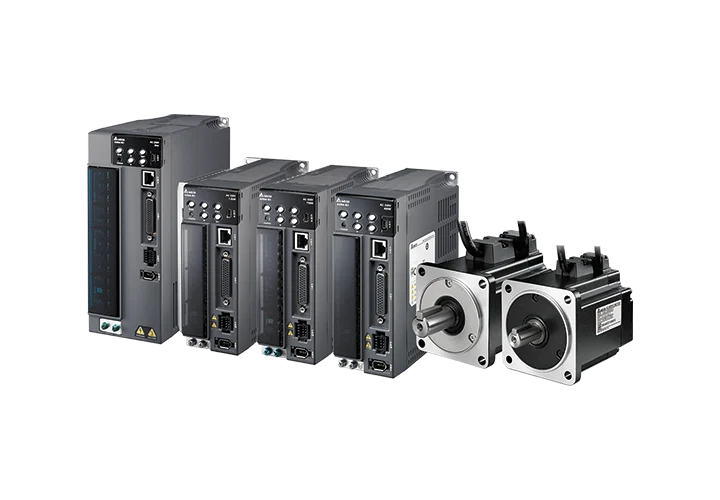
Delta ASDA-B3 family servodrive and servomotorDelta ASDA-B3 · drive and servomotor24-bit position feedbackASDA-B3 Delta Servo System

The drive and servomotor assembly transforms the calculated trajectories into movement. Each axis is dimensioned according to the load, the axis travel and the application cycle.

Encoder
24-bit resolution: 16,777,216 positions per motor revolution. The repeatability of the robot also depends on the mechanics and application.
Tuning
Autotuning and vibration suppression features support adjusting the drive to load dynamics.
Sizing
Power and torque selected for each axis, considering the product, gripper, drive system and path.
Security
Safe Torque Off (STO) integrated into the safety chain, according to the specified drive and system design.
Delta Documentation ASDA-B3
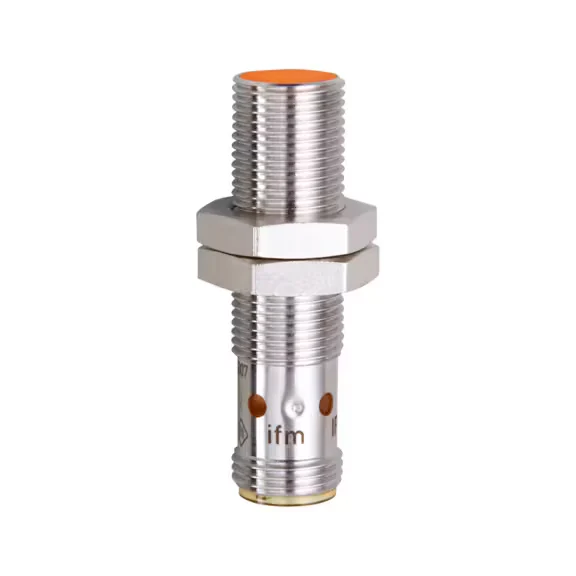
Example of cylindrical inductive sensor with threaded metal body and connectorInductive sensor · reference imageHoming and limit switchesInductive sensors

Non-contact mechanical detection provides position references for the axes and travel limit signals to the controller.

Reference
Axis homing combined with servomotor encoder reading.
Limits
Limit switch signals and software travel limits help control the motion envelope.
Selection
Model, range and environmental protection defined for assembly and operating conditions.
Reference image · ifm electronic
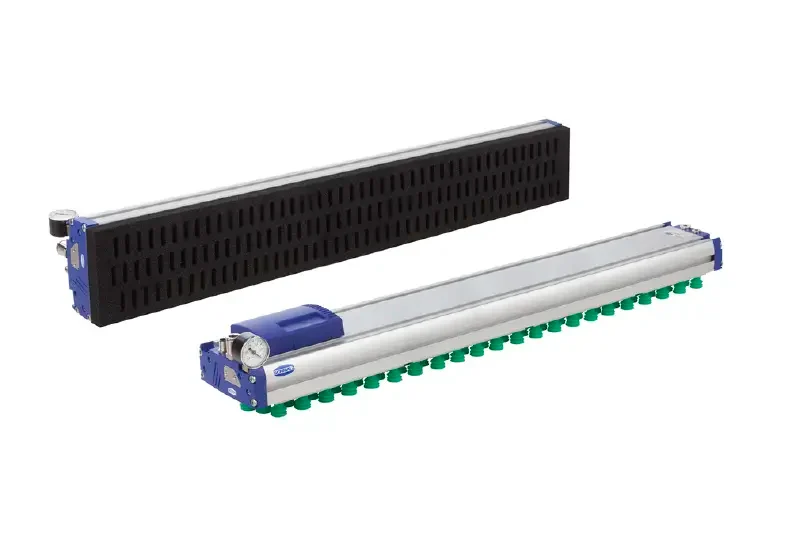
Gripper example of vacuum area for product handlingVacuum gripper · reference imageMechanical, pneumatic or vacuumGrippers and tools

The tool is designed for the product: boxes, bags, trays, bales or parts. Grip form, retention and orientation are evaluated together.

Mechanics
Driven by motor or servo, with opening and force adjusted according to the tool. The handle can dispense compressed air.
Pneumatics
Actuators and valves for grip and release; pressure and air consumption defined for the application.
Vacuum
Suction cups for gripping the surface, with assessment of sealing, porosity, packaging resistance and load retention.
Guidance
The rotation of the gripper guides the product during the cycle and layer formation. Drive and positions are defined in the project.
Reference image · Schmalz
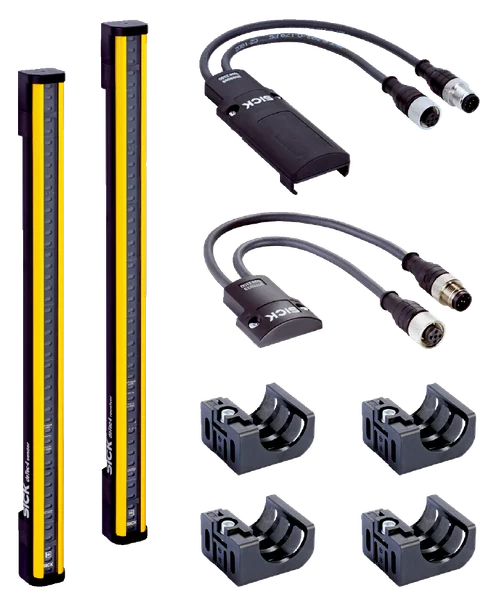
Example of light curtain assembly with emitter, receiver and mounting bracketsLight curtain · reference imageLayout, access and requirements of NR-12Operation protection

Protective measures are defined by risk assessment, considering the layout, supply and frequency of access to the machine.

Grating
Physical barriers and interlocking access, according to the needs of the operation.
Light curtain
Optical detection at planned accesses. Distances, stopping and restarting are defined in the safety analysis.
Laser scanner
Monitoring of areas with zones configured for the chosen layout and security architecture.
Set
Protections, interlocks and stop functions are integrated and validated to meet applicable NR-12 requirements.
Reference image · SICK
Request configuration for your project

Configurable mechanics

The right transmission
on each axis.

Spindle, rack or timing belt: axis travel, load, speed and precision guide the choice. The common basis is recirculating ball linear guides.

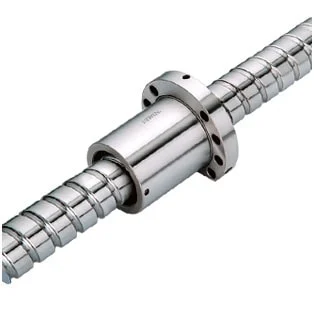
Ball screw assembly with helical shaft and nut
Reference image · HIWIN

Positioning and rigidity

Ball Screw

Converts rotation into linear motion by a set of recirculating spheres. The selection considers the required accuracy, the load and the axis travel.

Where it makes sense

Positioning applications and axes subject to greater efforts, depending on the dimensioning.

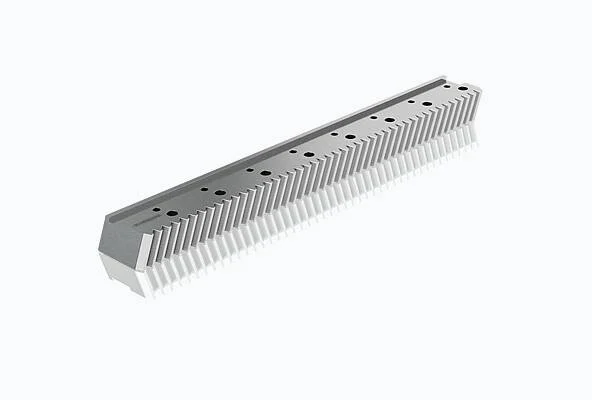
Metal rack with helical teeth and fixing holes
Reference image · SCHNEEBERGER

Long travel ranges

Rack and pinion

A modular transmission for long travel distances, with the rigidity needed for handling. It can be combined with other transmissions on the same robot.

Where it makes sense

Long axes, gantries and support for different positions of palletizing.

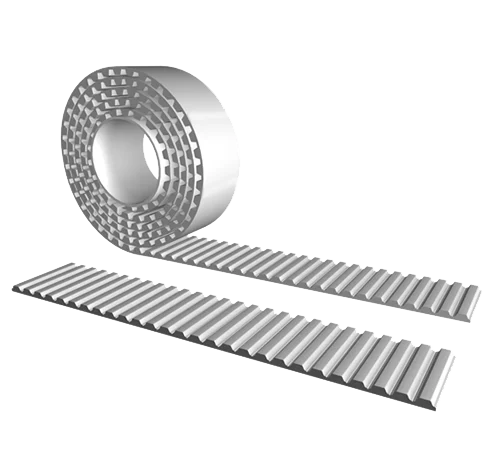
Examples of polyurethane timing belts with toothed profile
Reference image · BRECOflex

Movement agility

Timing belt

Timing-belt drive, selected when the moving mass, travel and throughput requirements favor this architecture.

Where it makes sense

Transfer and pick & place, considering the load and precision required by the process.

One robot, different transmissions.

A CR-NX can combine a rack in X, a belt in Y and a spindle in Z. The composition follows the demands of each movement; axis travel ranges and performance are defined for the application configuration.

Palletizing Carioli System

You provide the measurements.
The system calculates the movements.

A mathematical model developed by Carioli transforms the product dimensions into palletizing positions and trajectories. In the configurations covered, product exchange takes place by parameters, without teaching each point manually.

  1. Inform the product

    The product dimensions are included as configuration parameters.

  2. Calculate the pallet

    The mathematical model defines positions, heights and alternation of layers.

  3. Execute the movement

    The trajectories and deposit position consider the product's pick-up point.

The handle guides the tank.

The system considers the position in which the gripper picks up the box and compensates for this displacement when positioning it on the pallet. This reduces the need to centralize each product in the supply, within the conditions foreseen for the application.

More configuration in everyday life.

The operator reports the data and monitors the operation via the HMI. The software base already applied in the field allows different products to be serviced with the same palletizing logic.

Evaluate the palletizing in your line

From process to proposal

A technical talk before configuration.

  1. 01

    Understand the operation

    We gather product, load, cycle and layout data.

  2. 02

    Assess adherence

    We check configuration, integration and technical restrictions.

  3. 03

    Define the scope

    We consolidate assumptions, supply limits and proposal.

Your application starts with the right data.

Submit a description of the operation and, if available, product dimensions, weight, cycle and a simplified layout.

Present your operation

Before budgeting

Answers to the technical decision.

How much does a Cartesian robot CR-NX cost?

The value depends on load, axis travel ranges, number of axes, gripper, structure and integration. The budget starts by surveying the product, cycle and layout; There is no single price that represents all configurations.

What is the load capacity of the cycle time?

They are defined for configuration and trajectory. The cargo includes the product and the tool; the cycle includes picking, moving, releasing, returning and waiting. Send operation conditions to technical selection.

Is it possible to integrate with machines that are already in operation?

The assessment considers available signals, communication, timing, space and safety conditions. Necessary adaptations and interfaces must be included in the scope and proposal.

What is the manufacturing and installation time?

The timeline depends on configuration, component availability, site preparation, and integration. Manufacturing, assembly, testing and commissioning are different stages, with deadlines defined in the proposal.

How are installation, training and support defined?

Responsibilities, infrastructure preparation, training, documentation and support conditions need to be specified in the proposal. Application analysis identifies the needs of the operations and maintenance team.

When to evaluate a Cartesian versus a six-axis robot?

Movements between defined positions, linear axis travel ranges and the work area guide the Cartesian evaluation. Complex tool orientations and paths with many angles may require another architecture. The comparison must use the same load, cycle, range and integration.

Also assess ROI, payback and employee turnover ↗

Enlarged image